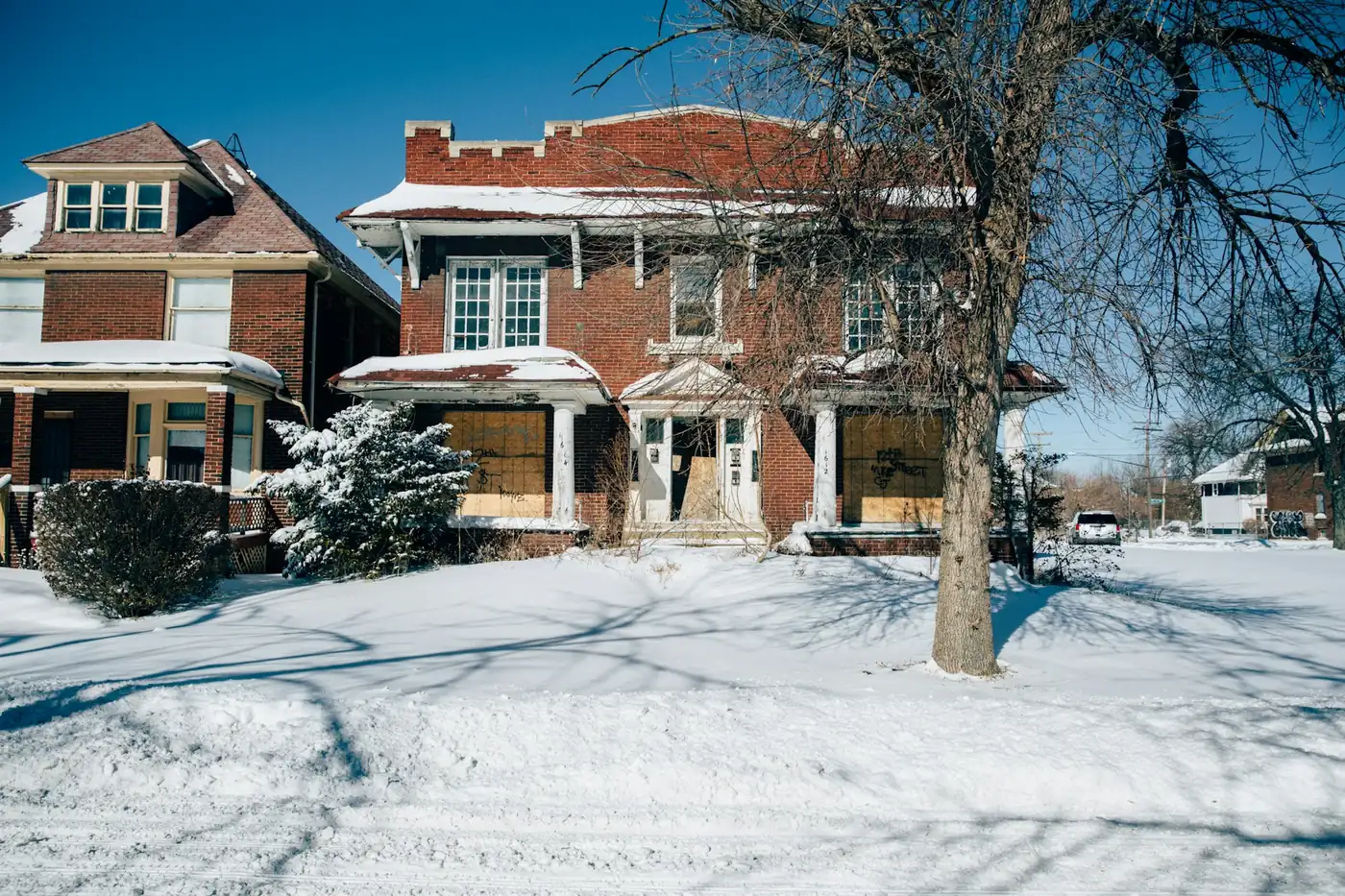
Exterior concrete in Troy, MI needs to be air-entrained because our winters freeze and thaw the surface dozens of times a season, and road salt makes it worse. Air-entraining admixtures create billions of microscopic bubbles in the concrete that give freezing water room to expand. Without them, the surface scales and spalls. The Michigan Residential Code requires 5 to 7 percent air on exposed porches, steps and garage floors in our region, and the Michigan Concrete Association recommends about 6.5 percent for driveways and walks.
What freeze-thaw does to concrete
Concrete looks solid, but it is full of tiny capillary pores. Rain, snowmelt and salty slush soak into those pores. When the temperature drops below freezing, that water turns to ice and expands by about 9 percent. If the water has nowhere to go, the pressure breaks the paste apart, popping off flakes at the surface. Each cycle does a little more damage.
The Detroit area sees a lot of those cycles. NOAA's engineering weather data for Detroit City counts about 47 freeze-thaw cycles a year. Add a typical snow season and road salt, and exterior concrete in Troy faces demanding conditions every winter.
How air entrainment helps
Air-entraining admixtures are added at the ready-mix plant. They create a uniform network of very small air bubbles throughout the concrete paste. When water in the pores freezes, it can push into those empty bubbles instead of cracking the paste. The bubbles act like pressure-relief valves, evenly spaced so no pore is far from one.
Air entrainment also improves workability, so the concrete places and finishes more easily. It slightly lowers strength, which is why mix designs compensate with a lower water-cement ratio.
What the code and the industry recommend
- Michigan Residential Code: In severe weathering regions, exposed porches, steps and garage floors need at least 3,500 psi concrete with 5 to 7 percent entrained air. Garage floors with a steel-trowel finish can use 3 percent air if strength is at least 4,000 psi.
- Michigan Concrete Association: For driveways and sidewalks, the MCA guidelines recommend 4,000 psi, a water-cement ratio of 0.45 and 6.5 percent air, plus or minus 1.5 percent.
Those numbers mean nothing if they are not on the delivery ticket. Ask your contractor what mix they order and whether it is air-entrained.
Finishing matters too
Air entrainment protects concrete, but finishing practices can undo it. Adding water to the surface to make finishing easier, or overworking the surface with a steel trowel on exterior concrete, can weaken the top layer and reduce the air near the surface. A broom finish on exterior flatwork gives traction and avoids sealing the surface too tightly. Proper curing then lets the concrete gain strength before its first winter.
What to ask your contractor
- What strength and air content are you ordering?
- Will the delivery ticket show the mix?
- How will you finish the surface?
- How will the concrete be cured, and for how long?
- What should I avoid the first winter?
Air-entrained concrete around Troy
Every exterior surface around Troy benefits, from driveways near Somerset Collection and the Big Beaver corridor to front steps in older neighborhoods. Steps and stoops, with thin edges and constant salting, are where poor mixes show up first. See concrete steps and porches for how we build them, and concrete driveways for driveway details.
If your concrete is already flaking, read why driveways spall after winter. If you are planning a fall project, see when to pour concrete in Michigan for cold-weather precautions.
Common questions
Is air-entrained concrete stronger than regular concrete?
Not in raw compressive strength. Entrained air slightly lowers strength, so mixes compensate with a lower water-cement ratio. What it adds is durability. Air-entrained concrete resists freeze-thaw damage and salt scaling far better than non-air-entrained concrete, which is what matters for driveways, walks and steps in Michigan.
Can I tell if existing concrete is air-entrained?
Not by looking at it. A lab can test a core sample to measure the air void system. In practice, a slab that has scaled badly after a few winters, while similar slabs nearby look fine, often lacked enough air or was finished with too much water. For new work, the delivery ticket should show the specified air content.
Do indoor slabs need air entrainment?
Interior slabs that never freeze, such as basement floors, typically do not need air entrainment, and air can interfere with a hard steel-trowel finish. Garage floors are different because salty slush freezes on them, so the Michigan Residential Code requires durable mixes there. Any exterior concrete in Troy should be air-entrained.