
A concrete driveway in Troy, MI should be at least 4 inches thick for passenger cars and 5 inches where delivery trucks, campers or heavy pickups will drive on it, placed over about 4 inches of compacted granular base. The approach in the public right-of-way is 6 inches in Troy, and the public sidewalk thickens to 6 inches where it crosses a driveway. Thickness works together with base, joints and mix; a thick slab on a poor base still cracks.
The numbers
- Private driveway, cars only: 4 inches minimum.
- Private driveway, heavier vehicles: 5 inches. The Michigan Concrete Association guidelines recommend 5 inches if delivery trucks will use the driveway.
- Base: About 4 inches of compacted granular base, more where soils are soft or wet.
- Troy approach: 6 inches in the right-of-way, under a Sidewalk and Approach Permit.
- Troy public sidewalk at a driveway: 6 inches; elsewhere 4 inches.
Other cities differ. Rochester Hills requires 6 inches of 3,500 psi concrete over 4 inches of 21AA aggregate for approaches in its right-of-way, and Warren's engineering standards call for 8-inch approaches in new developments.
Why the extra inch matters
Load capacity rises quickly with thickness. Going from 4 to 5 inches adds roughly 25 percent more concrete but a much larger gain in load-carrying ability. That is why a 5-inch slab makes sense where heavier vehicles cross, especially near the street and the apron where delivery trucks turn.
The base is half the story
A slab is only as good as what supports it. The base spreads loads, drains water and provides a uniform surface. Soft clay, organic soil or voids under the slab lead to cracks regardless of thickness. Good base work includes digging out unsuitable soil, placing aggregate in lifts and compacting each lift.
Joint spacing follows thickness
Control joints give concrete a planned place to crack. The MCA suggests spacing them no more than twice the slab thickness in feet: about 8 feet on a 4-inch slab and 10 feet on a 5-inch slab. Panels should be close to square, and joints should be cut or tooled early, before random cracks can form.
Reinforcement
Wire mesh, rebar or fibers help hold cracks tight but do not stop them from forming. They do not replace thickness or base. Reinforcement must sit in the right position within the slab to do any good. Some cities do not allow reinforcement in the approach within the right-of-way; Rochester Hills is one example.
Checking thickness on pour day
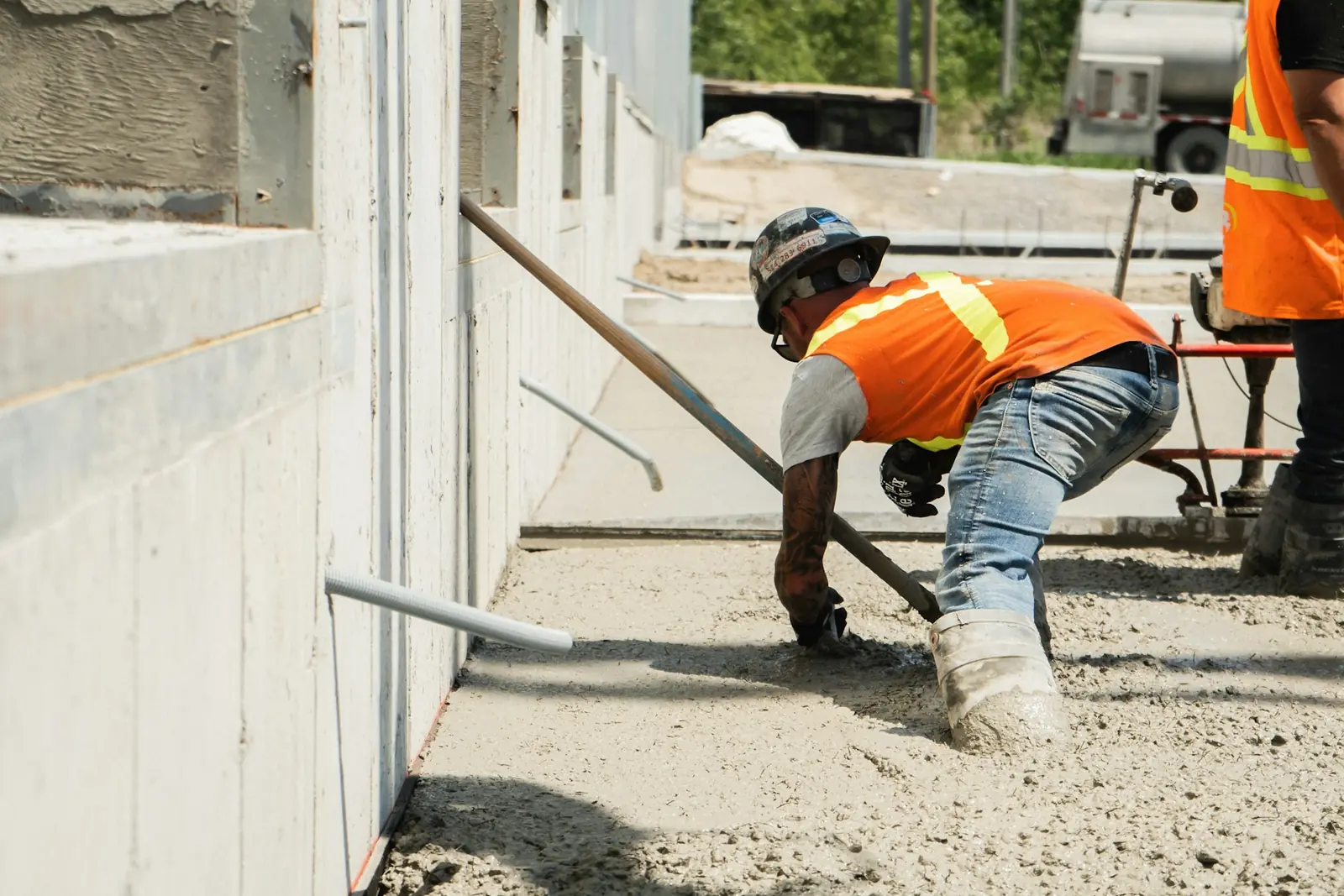
Ask how the crew will confirm thickness. Forms set to the planned depth, a level base and spot checks with a probe or tape before the pour are simple ways to make sure a 5-inch slab is really 5 inches everywhere, not just at the forms. Low spots in the base mean thin spots in the slab.
Edges and the apron
Driveway edges are weaker than the center, and the apron at the garage and the approach at the street see concentrated loads. Thickened edges or a thicker apron can help where vehicles turn or park near the edge.
Around Troy
Long two-car drives in the subdivisions near Firefighters Park often see delivery trucks and trailers, which makes 5 inches worth considering. Older drives near the Big Beaver corridor were often poured thinner and show it.
For full details on how we build, see concrete driveways. Commercial slabs carry heavier loads; see commercial concrete. For cost implications, read what a driveway costs in Troy, and for approach rules, see the Troy sidewalk and approach permit guide.
Common questions
Is 4 inches thick enough for a driveway?
For passenger cars on a well-compacted base, 4 inches is the common minimum. If delivery trucks, a camper, a boat trailer or heavy pickups will use the driveway, 5 inches is the better choice. The approach in Troy's right-of-way must be 6 inches regardless of the private driveway's thickness.
Does a thicker driveway prevent cracks?
Thickness increases load capacity, but it does not prevent cracking on its own. Concrete shrinks as it cures and moves with temperature, so control joints are needed to guide cracks. A compacted base, proper joint spacing, an air-entrained mix and good curing matter as much as thickness.
How deep should the base be under a driveway?
About 4 inches of compacted granular base is typical for residential driveways in our area, and more where soils are soft or wet. Rochester Hills, for example, specifies 4 inches of 21AA aggregate under approaches. Unsuitable soil should be removed first, and the base compacted in lifts.